





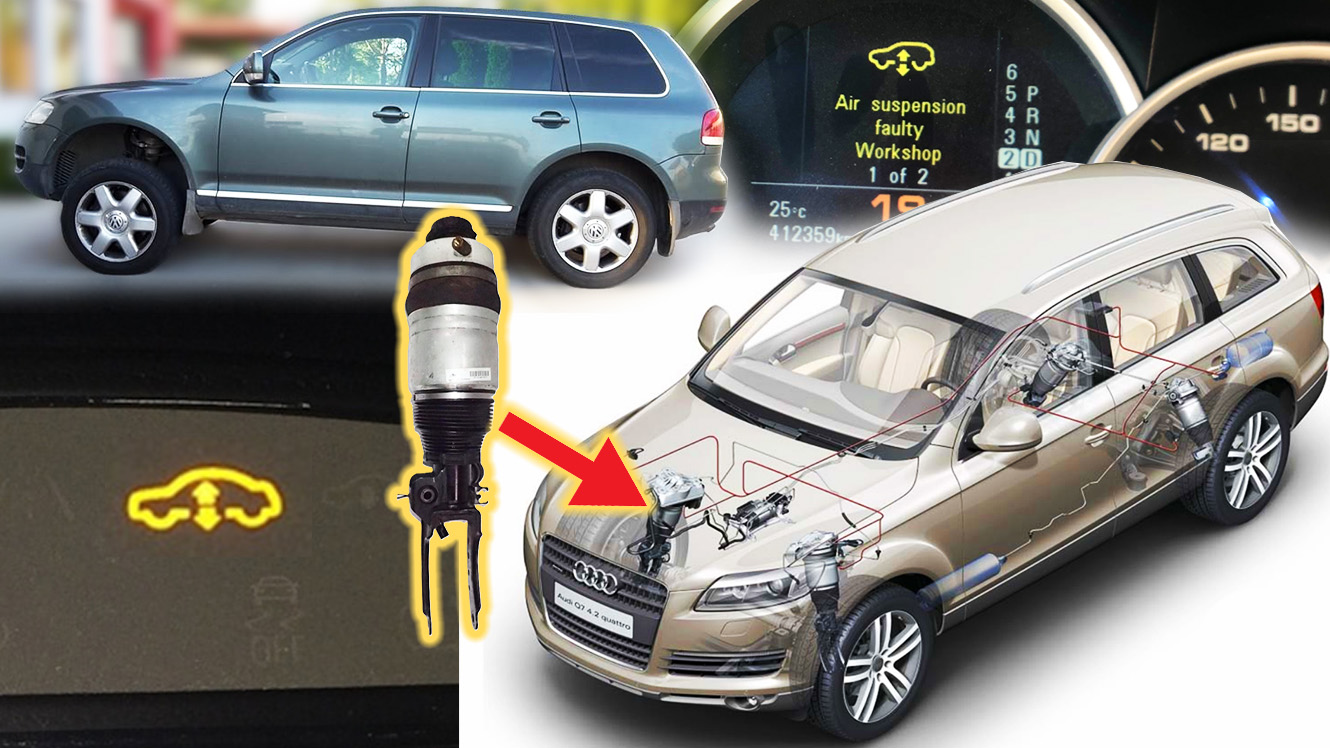
If you own a first-generation Audi Q7, Porsche Cayenne, or VW Touareg equipped with air suspension, sooner or later you’ll likely experience an air leak in the system—most commonly from the air struts themselves.
A complete new air strut can cost anywhere from around $200 for a low-quality aftermarket unit to as much as $3,100 for a genuine, high-quality part. However, don’t rush to replace the entire strut, because the fix is often much cheaper than you might expect.
The original factory air struts in these vehicles are extremely well-built and among the most durable you’ll find in any passenger car. In many cases, they can last up to 500,000 km without significant wear or failure of the main components. Let’s take a closer look at how they’re constructed.
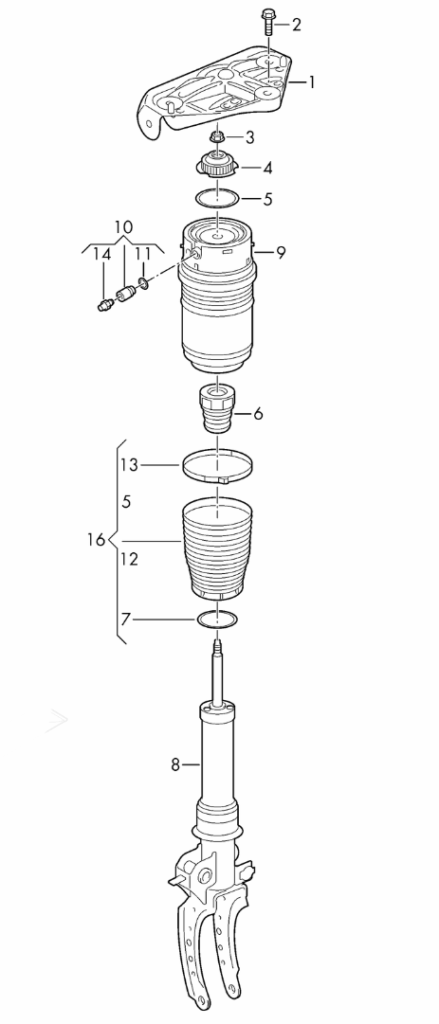
Although the front and rear air struts differ slightly in appearance, they share the same basic design and are prone to the same issues.
Each air strut consists of:
- a shock absorber with electronically adjustable damping
- a standard bump stop
- the air spring (airbag) itself, which uses upper and lower O-rings for sealing
- a residual pressure valve mounted in the upper section of the strut
At the top, you’ll find a rubber strut mount, and the entire assembly is attached to an aluminum bracket, which is then bolted to the vehicle. Overall, the construction is quite straightforward—and importantly, most of these components can be purchased and replaced individually!
Failure points
The most common failure points of these air struts are the residual pressure valves and the o-ring on the top of the strut. But first the valves.
Residual pressure valve
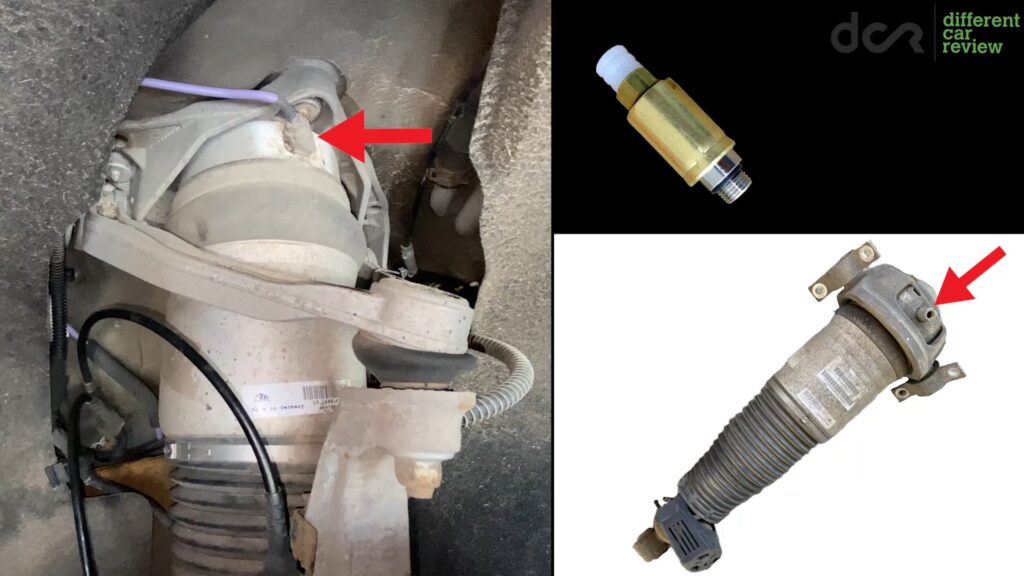
There is a residual pressure valve on each air strut which can get stuck, or it can simply leak air. A stuck valve is easy to spot, since in this case usually the front or rear side of the car will be stuck in higher or lower position, and of course the air suspension system is not gonna work correctly either. In this case you have to replace just the valve itself (preferably both of them) on the affected front or rear side. There is a special socket which you can buy to replace the valve easily, however if you are in a rush then a regular vice grip is gonna somehow do the job as well.
The next problem related to this valve is a slow air leak. Long story short: on cars used on winter salty roads corrosion will appear around the valve – which is gonna slowly spread onto the threads of the valve creating an air leak. So if you got an air leak, then definitely check this valve first and as a preventative measure clean this area regularly, eventually put some wax on it. By the way if the thread of the valve is corroded too much then it is possible that you are gonna break the valve during removal.
And last but not least on the oldest cars, the small o-ring on the valve itself can eventually let the air out too and even if there is no significant corrosion around the valve!
O-ring on top of air strut
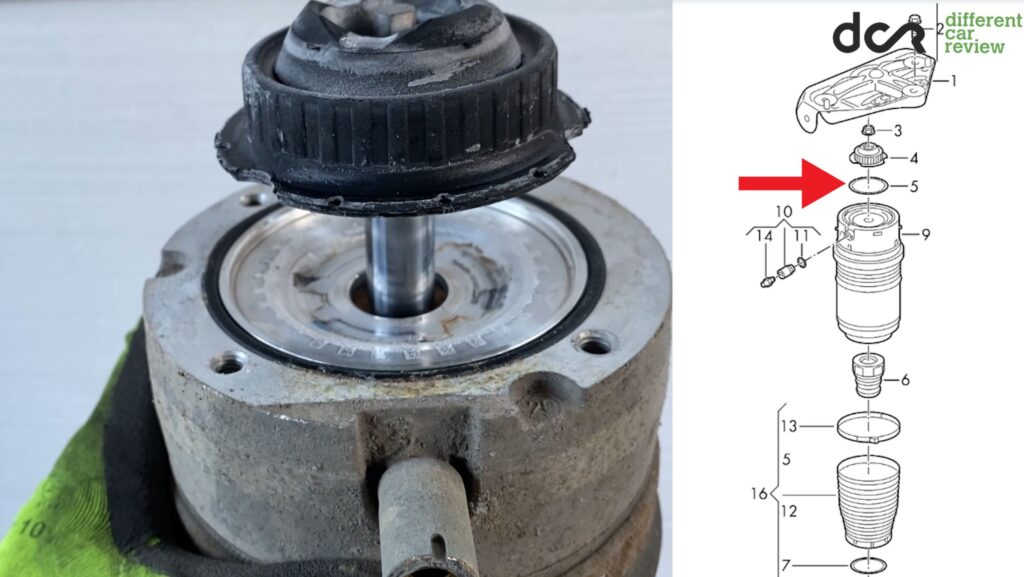
If there’s no air leak from the residual pressure valves, then the next—and most likely the REAL culprit is the O-ring at the top of the air strut. This inexpensive component inevitably fails over time because the rubber gradually flattens and loses elasticity, allowing air to slowly escape. On vehicles driven in winter conditions with salted roads, corrosion can also develop in this area, which can accelerate air leaks.
Replacing the top O-ring is cheaper than replacing the residual pressure valves and doesn’t require any special tools. However, you will need to remove the entire air strut to access it, which is doable but somewhat time-consuming. If you have some spare time, it’s a good idea to replace this O-ring on all struts proactively. Even a slow air leak increases wear on the air compressor and, over time, can lead to complete failure, which disables suspension height control.
The lower rubber O-ring, which seals the bottom of the air strut, is much more durable – but it won’t last forever, so I recommend replacing it while the strut is removed. With the strut out, you can also inspect the rubber top strut mount. This component is generally durable, but it may develop cracks over time. On high-mileage or heavily used vehicles, it can even separate, causing knocking noises.
Other sources of leaks
That covers the most common failure points within the air strut itself. If you’re dealing with an air leak, it’s always best to start by inspecting or replacing those components first, as they are by far the most frequent culprits!
However, in some cases, the problem may lie elsewhere in the system. One such component is the valve block, which is typically located near the air compressor. This unit is responsible for distributing air to each individual strut and maintaining the correct pressure. Over time, its internal seals/components can wear out or become contaminated, leading to small but persistent leaks. These leaks can sometimes be difficult to diagnose, as they may mimic the symptoms of a failing air strut.
Another potential, though less common, source of leaks is the air lines themselves. These lines run between the compressor, valve block, and individual air struts. While they are generally quite durable, they can still be damaged—most often by external factors. For example, their close proximity to surrounding components can lead to rubbing over time, eventually wearing through the line. They may also be affected by road debris or improper handling during previous repairs. Even a small crack, pinhole, or loose fitting is enough to cause a gradual loss of pressure in the system.
It’s also worth mentioning that the air spring (airbag) is not a lifetime component. Although it is protected by an outer structure and designed to withstand significant stress, it is still made of rubber, which naturally degrades over time. Factors such as temperature changes, road debris, and constant flexing all contribute to its gradual wear. Eventually, cracks can form, leading to leaks that typically worsen over time.
That said, based on real-world experience, the airbag itself is not usually the primary cause of failure—especially in these vehicles. More often, leaks originate from seals, fittings, or other serviceable parts of the air strut assembly. This is why a thorough inspection and targeted repair can often save a significant amount of money compared to replacing the entire unit.
Air struts after 500 000 km / 310 000 mi
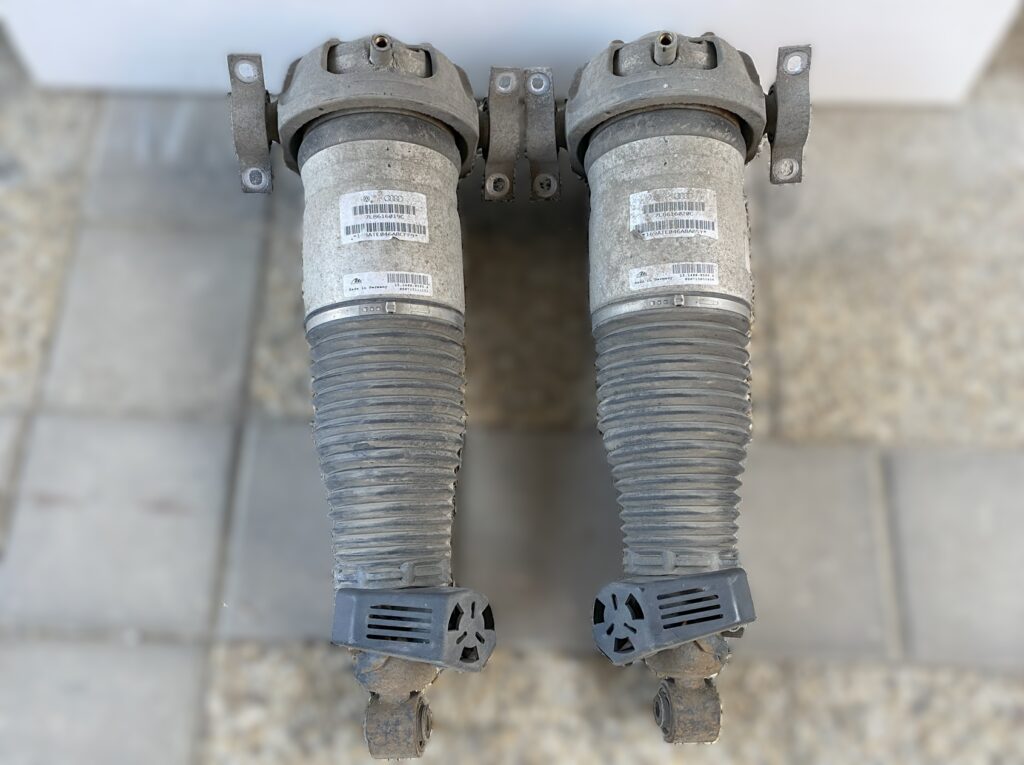
To wrap things up, it’s worth looking at a real-world example from a 2008 Audi Q7 with 500,000 km I had. This particular car was equipped with its original rear air struts, which had never been replaced.
They were removed due to a slow air leak—something that becomes increasingly common at higher as well as lower mileage. Despite this, their overall condition was surprisingly good. Aside from some expected surface rust on the lower sections, there were no major signs of structural deterioration. The bushings did show wear, appearing dry, slightly compressed, and with minor cracking, but given the mileage, this is entirely understandable and still within acceptable limits.
The actual source of the air leak turned out to be corrosion affecting the sealing surface, which compromised the rubber seal and allowed air to escape. In cases like this, a thorough cleaning combined with a seal replacement can often restore proper function, at least temporarily, without the need for a complete strut replacement.
Another component showing age was the upper rubber strut mount. Visible cracks indicated that it was nearing the end of its lifespan, even though it was still holding together.
What’s particularly impressive is the condition of the internal components. The shock absorber remained dry with no signs of oil leakage, the bump stop was intact, and the internal rubber parts were still in very good shape, without cracks or degradation. For a vehicle with half a million kilometers, this level of durability is genuinely remarkable.
If you’d like to see the full teardown and a detailed look at these components, be sure to check out the video where everything is shown step by step.