






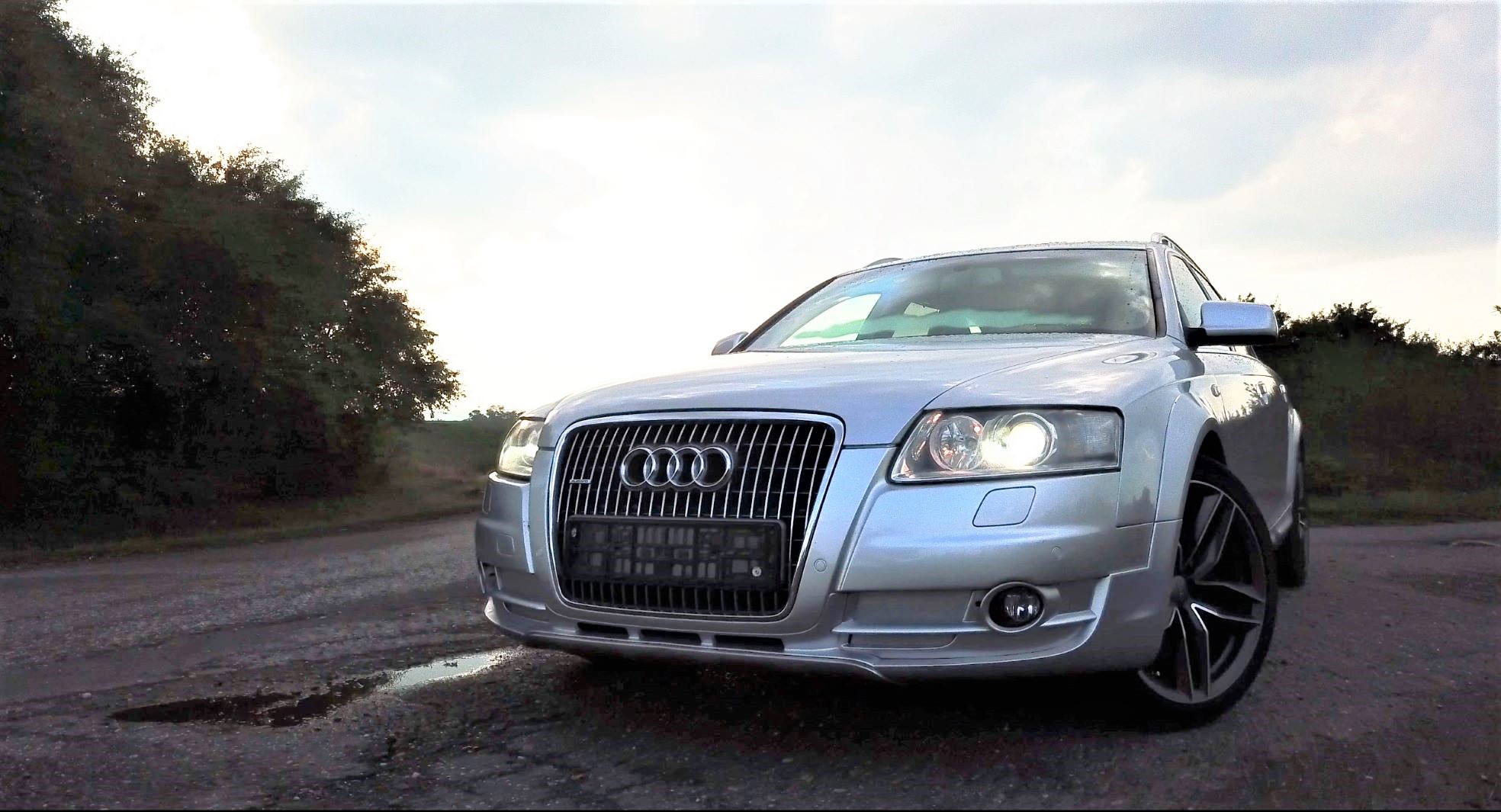
Petrol engines
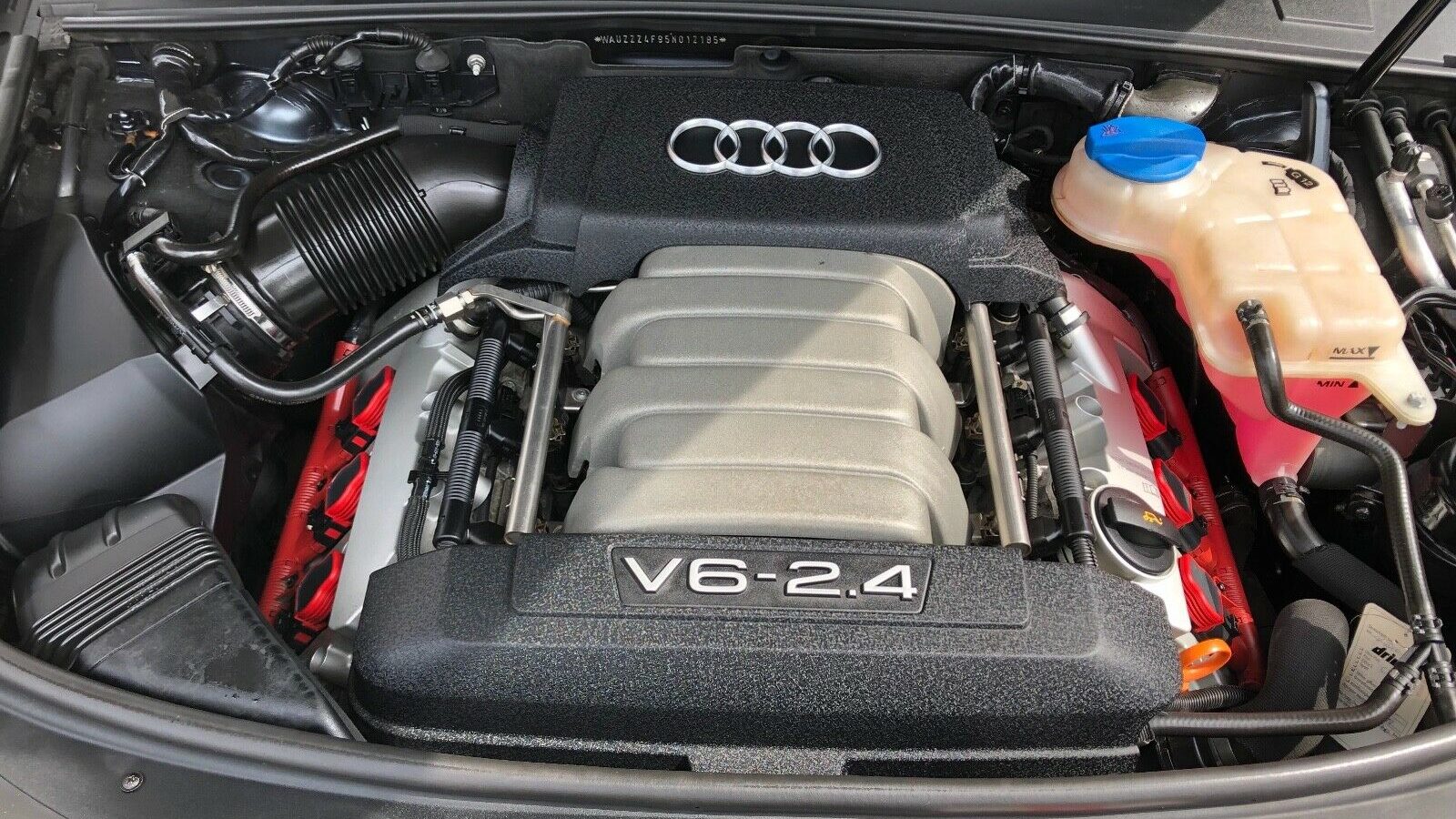
2.4 V6, 4.2 V8
From the petrol engines the most reliable is the 2.4 l naturally aspirated V6 unit. It doesn’t have direct injection and it doesn’t have a turbocharger either so it is simple and reliable. On the other side it’s definitely not powerful (although for a regular/casual/calm cruising it will be ok), and the high mileage examples (250 000 km or more) can suffer from smaller or bigger oil consumption.
Then there is the second most reliable engine which is the older 4.2l V8, again, not equipped with the direct injection. In this case it is definitely powerful enough but it’s also much more prone to different oil leaks (valve cover gaskets, oil pan, oil filter housing etc.) so definitely check for leaks and for burnt oil smell around the engine + have some extra money left since these oil leaks are sometimes not the cheapest to repair.
Other engines
All the other engines are equipped with direct injection so you can expect:
- the well-known carbon build up on the intake valves (misfires, loss of power)
- faulty injectors (misfires, loss of power and sometimes they can leak causing funny stuff which Im not interested to explain since nobody is paying me for this)
- faulty HPFP causing: bad/rough engine start and rough idle, slight external or internal fuel leak.
2.0 TFSI
The 2.0 l 4 cylinder TFSI is actually not a bad engine and with regular maintenance in can easily reach 300 000 km, but of course the abused examples will have problems with the turbocharger or with excessive oil consumption + in higher mileage cars it’s also good to check the camshaft follower which is connected to the high pressure fuel pump. This part is cheap but it can be worn out and cause damage to the camshaft, fuel pump or it can send metal particles into the cylinder head. Also check for fuel leaks from the high pressure fuel pump because it will leak fuel from the solenoid valve as its getting older! high pressure fuel pump fuel leak location video
2.8 FSI, 3.0 TFSI
Then there is the 2.8 l FSI and the 3.0 l TFSI. These engines are not the worst but they can have the already mentioned direct injection related problems + sometimes leaking water pump + mainly the 3.0 l TFSI can have smaller or bigger oil consumption.
3.2 FSI
The 3.2 FSI V6 again doesn’t have any huge issues except the direct injection related stuff and the various oil and coolant leaks. For example the valve cover gaskets, the oil filter housing or the rear timing chain covers will leak at some point. You can fix these leaks without removing the engine, although it’s definitely not always easy and in some cases you have to disassemble a lot of things to fix them. + there is one high pressure fuel pump which will leak fuel from the solenoid valve as its getting older! high pressure fuel pump fuel leak location video
4.2 FSI V8
Lastly there is the 4.2 FSI V8. This engine is also affected with the well-known direct injection flaws and it will also-in a lot of cases-leak oil and coolant. However in this case because of the lack of space you have to remove the whole engine if you want to fix certain leaks – like for example the the rear timing chain cover leak or the spark plug tube leak. + There are two high pressure fuel pumps which will leak fuel from the solenoid valve as they are getting older! high pressure fuel pump fuel leak location video
+The variable intake manifold in this engine is a complicated piece of shit actually. And why? Well, because of the plastic insides mainly. But long story short:
- the inside of the intake manifold gets dirty over time
- the plastic bits in it are gonna get brittle – break – and fall apart (eventually the bits can be sucked into the cylinders IN THE WORST CASE-so rarely I guess)
- the 2 electric actuators mounted on front of the manifold can fail too
The only good thing is that these issues are gonna occur usually just after 200 000 km – 250 000km.
4.2 FSI → How to replace the engine air filter and the spark plugs video
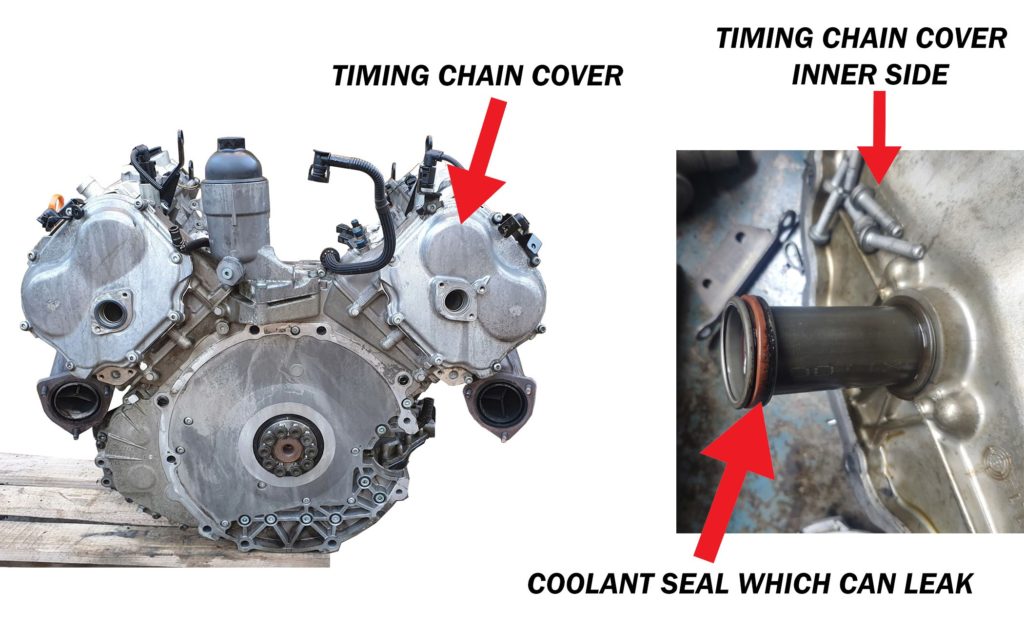
Coolant leak which will kill this engine
-Behind the engine there are the timing chain covers. These covers do have a hole in them thru which the coolant flows. This would be fine, but it’s not. It’s not fine, since the coolant seal on these covers can fail and let the coolant leak directly into the engine-into the oil. Long story short: If you don’t catch this early then you will end up with a destroyed engine.
Other stuff
can adjustment solenoids
All these petrol engines can have faulty camshaft adjustment solenoids and these parts have been actually revised several times. They can get stuck because of long oil change intervals – and in this case you get fault codes for the camshaft position, misfires or fluctuating/bouncing idle. These solenoids can leak oil as well, but in this case there is no need to replace them completely – you just need to change a small o-ring on them.
vacuum leaks
Vacuum leaks can occur on all the petrol engines, so be ready for cracked plastic or rubber vacuum hoses and faulty PCV. (vacuum leaks symptoms: slight misfires, uneven engine running, eventually check engine light + the faulty PCV can cause oil consumption too)
The petrol engines have to be perfectly smooth at idle and during acceleration as well.
Long story short: if you are buying a petrol engine then make sure that you start the car when it’s cold and check for shaking/uneven idle. This is caused by misfires which can indicate excessive carbon build up, faulty ignition coils, faulty injectors or other issues.
Don’t forget to check also the coolant while the engine is stone cold – it has to be light red and clean without any kind of oil traces or oil smell. If there is oil in the coolant, then the engine most probably has serious issues like leaking head gasket or cracked cylinder head, and believe me, you don’t want to deal with any of that shit, just run away.
All petrol engines can have broken exhaust flexible pipes.
Diesel engines
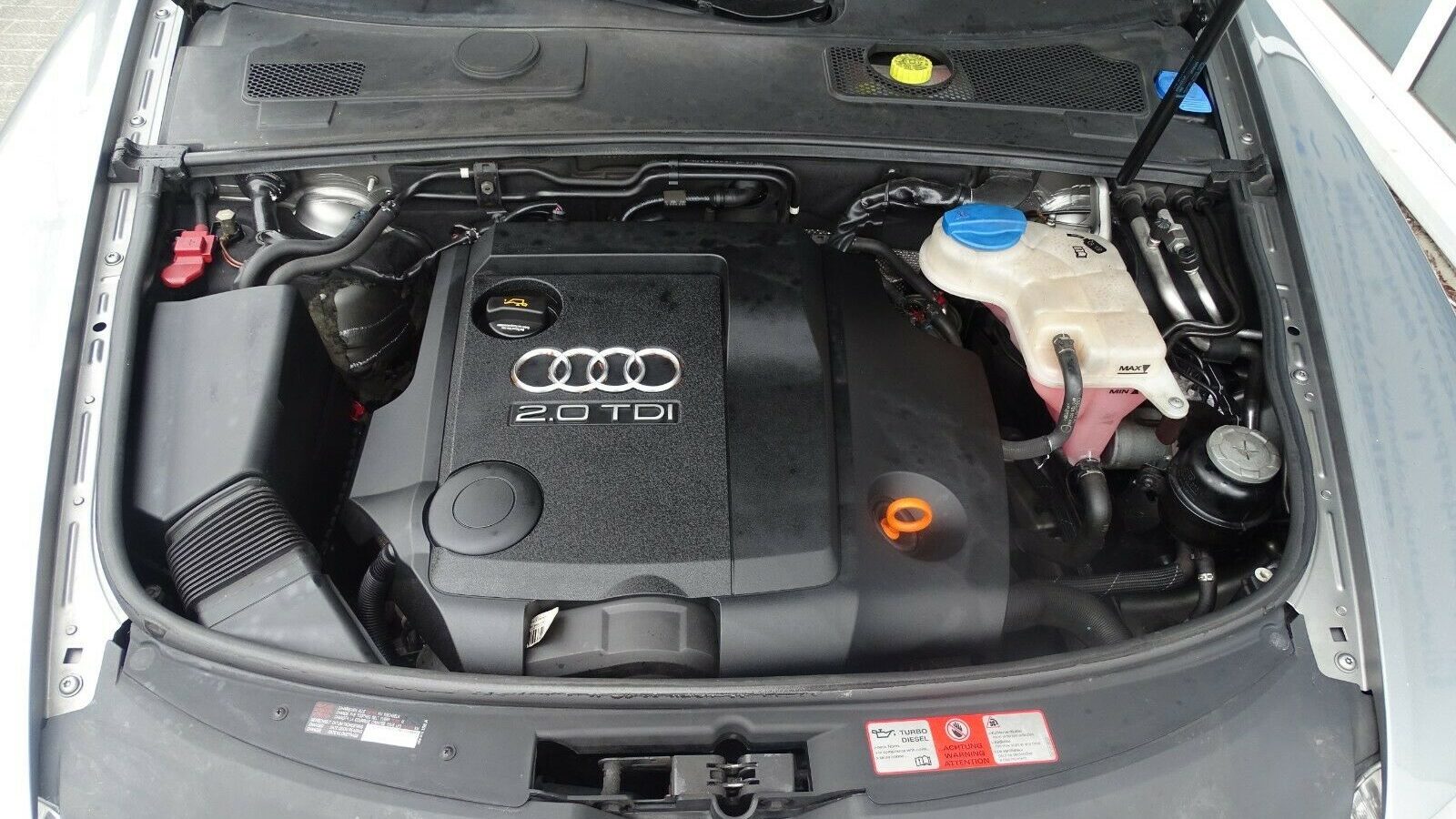
The diesel engines don’t have unexpected major issues except the 2.0 l TDI 4 cylinder.
2.0 TDI
This smallest diesel engine with the older PD injection system can have problems with the worn oil pump drive which can fail – in this case the engine will lose oil pressure and this will most probably kill the turbocharger and it can of course do other more serious damage too – this depends how fast you shut off the engine after the low oil pressure warning comes on. The oil pump drive can be worn after 100 000 km or just after 200 000 or 300 000 km, so nobody knows when exactly but you can check the condition of it after you remove the oil pan. By the way even the newer 2.0 l units with the common rail injection can have this issue but not that often as the older versions. Replacing the complete oil pump drive module can cost up to 3500€, but this obviously depends on the actual damage so it’s a lot cheaper to replace it preventively. So I would just stay away from at least the older generation 2.0 l TDI engines because they can have not only worn oil pump drive, but more often faulty injectors + there are more often cases of cracked cylinder heads and some other not interesting stuff. And if we take into consideration that most of these engines have nowadays more than 250 000 or 300 000 km then it really is not a good idea to recommend them.
2.7 TDI, 3.0 TDI
Then there is the 2.7 l and the 3.0 l TDI. Both of these engines are technically speaking basically the same so they have the same issues:
-first there are the intake manifold flaps which can sometimes fail. The flaps can be stuck, loose or the actuator motors can be faulty. In this case you get only a check engine light-so the car will drive fine. The whole intake manifold part is obviously expensive (around 500 €/side) but you can find repair kits for a much reasonable price.
-then it’s also good to check and eventually replace the crankshaft pulley vibration damper mainly in cars which were used on winter salty roads. Since over time the inner part of the pulley will rust out and separate from the outer part. This will leave you stranded because the accessory belt will jump off-so it’s better to check this pulley before you will wonder what the hell happened !!
And the last two things related to these 6 cylinder engines:
–the high pressure fuel pump has a separate belt and a tensioner. Most of the owners don’t even know that there is a separate belt for the high pressure fuel pump, so it’s good to replace these two parts if the car has more than 200 000 km or 10 years.
-lastly, if you are buying a car which has around 300 000 km then be prepared to replace the alternator since its lifetime is approximately the already mentioned 300 000 km
When it comes to injectors, yes they can be faulty on all the diesel engines, but usually just after 200 000 km. Of course they can last way over 300 000 km as well, but this depends on many different things including the fuel quality used or the year of the engine. But all you need to know is, that if you got faulty injectors then you will most of the time notice a couple of signs like the: occasional light grey smoke from the exhaust while acceleration/or at idle, issues with starting the engine, a slightly bouncing idle when the engine is warmed up, or an increased fuel consumption.
CP4 HPFP
The newest diesel engines made from late 2008 (so the 2.0 TDI 125 kw, 2.7 TDI 140 kw, 3.0 TDI 176 kw) are equipped with the infamous Bosch CP4 high pressure fuel pump which can sometimes fail even after 150 000 km (MOSTLY JUST in the Eastern EU because of the different fuel quality). If it fails it will throw small metal particles in the fuel system, thus destroying the injectors, the HPFP + these particles can contaminate the fuel tank as well. So in this case the whole or just certain parts of the fuel system including the injectors and the high pressure fuel pump has to be replaced and eventually cleaned. Repairing this can cost up to 4 000 €-independent mechanic, up to 6 000-7 000 € at the dealer.
More information about this failure in this BMW X5 article.
The 4 cylinder engines are equipped with a timing belt so just make sure that it was replaced in time. Also keep in mind that you should replace not only the timing belt but also all the tensioners and you should definitely install new tensiononer screws as well, because there are cases when the owners re-used the old screws and the screw broke causing a serious engine damage + of course replacing the water pump preventively is a good idea as well.
Timing chain
The other engines are equipped with timing chains. The tensioners and the plastic guides can be worn + the chain can be stretched, but usually just after 200 000 km – in this case you get the well-known short rattle at cold start.
The funny thing is, that there aren’t many catastrophic engine failures because of the timing chains at least amongst the diesel engines. Because the petrol engines are actually more prone to a chain mechanism failure in which the chain mostly skips a tooth making the engine run like garbage or the plastic guides crack causing a rattling noise and other funny stuff. But at the end of the day it’s up to you, if you got the short rattle then you can wait or you can preventively replace the tensioners and the chain. The timing chains are located on the back side of the engine so this is not the cheapest repair since you have to remove the engine to change them.
Generally speaking at 300 000 km its definitely good to preventively replace the chain if it was not replaced in the past.
By the way if you got one of the 6 cylinder engines and if you have around 200 000 km or less than 200 000 km, but you hear the rattle then you can first replace only the upper chain tensioners which will solve the rattling and this will prevent the excessive wear of the chain+the upper tensioners can be replaced without removing the whole engine. (how to replace the upper chain tensioners 3.2 FSI)
Transmissions
This A6 can be equipped with the 6 speed manual gearbox or there are 2 types of automatic transmissions.
Manual
-The 6 speed manual is reliable, however check the clutch properly before buying – it should operate smoothly without any kind of strange noises, vibrations or shuddering. If you are buying a diesel engine with the manual gearbox then have extra money left for the Dual mass flywheel which can be worn. In this case it can, except the already mentioned symptoms, also cause vibration at idle or metallic clattering sounds from the gearbox area. To extend the lifetime of the dual mass flywheel you should always release the clutch calmly rather than releasing it suddenly and never let the engine to operate at low RPM – so make sure that while driving the RPM stays above 1 400 RPM.
(new clutch + DMF – 2 500€ at the dealer, new DMF only – 1 000€)
Tiptronic
-From the automatic transmissions the regular 6 speed Tiptronic is the most reliable although after 250 000 km you should be prepared to replace the torque converter since it can be worn out mainly if the previous owner never changed the gearbox fluid. + of course check it properly before buying
Multitronic
-The Multitronic is a CVT gearbox which is still not very reliable, although it’s at least more reliable than in the previous generation of this A6. Long story short with regular oil changes and with a regular/not aggressive driving style it can withstand even more than 200 000 km, but of course after this mileage point the lifetime of the gearbox starts to be questionable. Without regular oil changes and with more dynamic driving it can fail after 150 000 km or even before this mileage point.
If you really want the multitronic gearbox then check it properly before buying. If it’s shuddering or if it’s not working completely smoothly then run away and find another car. (the price for repairing the multitronic gearbox usually starts at 1 900€)
All of the automatic transmissions have to change gears without shuddering, strange sounds, fluctuating RPMs and they have to be smooth and especially the Multitronic has to work perfectly smooth all the time.
Quattro
The Quattro is still that good, old school, mechanical and very reliable permanent 4WD system. Usually it doesn’t have issues even in high mileage cars and it doesn’t require bigger attention/care. HOWEVER:
- it’s very important to have the exact same tires with the same tread depth on the front as well as on the rear axle
- it’s good to occasionally change the oil in the front and rear differentials and even in the transfer case (replacing the transfer case oil can help to eliminate the low speed “quattro growl”)
- in cars with more than 250 000 km it’s good to check the propshaft for excessive wear → check for vibrations or shuddering at hard acceleration from stand still or for a vibration at highway speeds which can indicate worn propshaft.
To summarize things up:
- the simplest most reliable version is a saloon/sedan model with the 2.4l petrol engine and with the manual gearbox or with the 6 speed Tiptronic gearbox
- the 2.7 TDI and 3.0 TDI engines are very good but keep in mind the issues they can have after 200 000 km
- find a good independent mechanic
- keep at least 2 000 € for the possible repairs
But if you are buying a car which have more than 200 000 km or if you are buying a V8 engine then you should keep at least 4 000 €. And to top of that, if you want a car with the air suspension then you should keep an additional 3 000 €, which means that if you want a V8 with an air suspension then you should keep 9 000 €, unless you can fix your own stuff of course.
And if you have personal experience with this car or more information about it, then you can write it into comments!







Thanks for your indepth review. I had an Audi A 6 , 2002 Diesel with 163 Horsepower which was a great car to drive but sunk my budget with repairs. Now is the time to look for a new ( used car) and I hope that the Audi
A6 Series built betwenn 2004 – 2011 is more reliable. I think to be on the safe side a car should have
a maximum age of 10 years to avoid all the repair problems which can be quite expensive if you can not
do the repairs yourself.
Great guide, I mean really it’s the best one I was able to find for this model. Thanks for putting all of this together especially the section about water leaks. I made a complete checklist of what I want to look at before buying. Currently hunting for a decent pre-facelift (up to 2008) C6 because it’s the last chance to get A6 with MPI before they completely submerged in the stratified direct injection swamp. Can live with all the problems this series can have but reliable engine is my top priority. FSI is not bad and if someone is willing to give it the love it needs it’s probably a great engine to have but with most C6’s up sale now being past 200 000 km mark MPI will last longer without injector failures and all the fun stuff FSI can serve you with. 2.4i feels like the perfect engine for a reliable daily driver, without turbo and direct injection only things that might require attention are the tensioners and possibly ignition coil known to fail. I plan to do both after purchase and hope my V6 will only require oil changes, spark plugs and such typical maintenance afterwards. If that’ll be the case I found my perfect car.
Thanks at all for the info!!!
I you colud say to me the referece of the hall sensor ubicated in the F125 component in a cvt gearbox ECU.
Thanks!!